
by Eleonora | Jul 8, 2026 | Custom interior Decoration
Designing small spaces requires much more than simply choosing materials and finishes. Every available centimeter must be analyzed, evaluated, and transformed into a design asset through a process that combines interior architecture, custom design, and furniture engineering.
The micro-duplex built in Bergeggi perfectly exemplifies this approach. Spanning just 40 square meters across two levels, the project required constant oversight of every phase: site survey, modeling, detailed design, fabrication, and installation.
The goal was not simply to furnish a space, but to build an integrated system capable of transforming the home’s geometric constraints into design opportunities.
Interior Architecture: Designing Based on the Geometry of Space
The trapezoidal floor plan of the home became the starting point for the entire interior design project.
Instead of correcting the irregularities, the design transformed them into the compositional language of the project, creating a dialogue between architecture and furnishings through perfectly integrated volumes, cuts, and geometries. The color scheme also draws inspiration from the house itself: the existing hexagonal cement tiles define the palette of powder blue and ochre yellow, colors that are echoed in the custom-made furniture, creating continuity between the two levels.
Custom Kitchen Design
One of the most complex aspects involves the kitchen, which is situated beneath an existing metal staircase.
The extremely tight tolerances required a true engineering effort in the design of the cabinetry, with panels trimmed directly on-site to ensure a perfect fit with the structure. The under-stair cabinet faithfully follows the staircase’s geometry, transforming a structural constraint into a distinctive element of the design. Carrara marble, used for the countertop, backsplash, shelves, and sink, ensures material continuity, helping to establish a cohesive aesthetic throughout all the rooms.
Interior Design and Space Optimization: Modular Cabinetry
The upper floor is the heart of the design.
The goal was to create two bedrooms within an extremely small space characterized by out-of-square walls.
To solve this problem, a movable modular wall system was designed that can perform three functions simultaneously: closet, room divider, and space-transforming element.
The entire system rotates up to 270°, completely changing the layout of the rooms.
Before construction began, each movement was verified using a 1:1 scale drawing, which was used directly on-site to check the dimensions and ensure the element rotated perfectly. This type of verification is one of the most significant aspects of design engineering, as it allows for the anticipation of potential issues and the optimization of the installation phase.
From Design to Construction: When Engineering Translates into Construction Quality
Every solution we adopt stems from ongoing collaboration between designers, the engineering department, and the woodworking shop.
The engineering of furnishings is not limited to production but represents a working method that accompanies the entire design process: precise site surveys, detailed modeling, dimensional checks, prototyping, on-site supervision, and installation. It is precisely this integration between design and execution that allows us to achieve results in which every detail has a technical as well as an aesthetic rationale.
The micro-duplex in Bergeggi demonstrates that the quality of a design does not depend on the available floor space, but on the ability to turn every constraint into an opportunity. Through custom design, engineered furnishings, and rigorous on-site supervision, even forty square meters can become a model of interior architecture that successfully combines functionality, precision, and identity.
by Eleonora | Jun 12, 2026 | Custom interior Decoration
Designing a home in the mountains involves addressing needs that are very different from those of a traditional home. Space must be optimized, materials must blend with the surrounding landscape, and every element must contribute to creating a welcoming, functional, and durable environment.
The project designed by the Saglietti Group for a duplex in Sestriere stems precisely from this vision. The approximately 60-square-meter apartment, spread over two levels and overlooking the Olympic mountains, has been completely reimagined through custom-designed furnishings that make the most of every available inch.
From the very early stages of the project, it was clear that the goal was not simply to furnish a home but to create an integrated system in which architecture, interior design, mechanical and electrical systems, and woodwork would interact harmoniously. The project was developed in collaboration with the GOODFOR Studio in Turin, led by architect Marco Luciano, who coordinated the architectural and interior design choices, transforming the apartment’s spatial limitations into design opportunities. A key contribution also came from the mechanical and electrical systems, designed and installed directly by the owner, Paolo, through Canavese Impianti. The integration of underfloor heating, controlled mechanical ventilation, and a humidification system ensured maximum living comfort in an alpine setting characterized by low temperatures and particularly dry air.
The Value of Custom Furniture in Small Spaces
When space is limited, furniture shouldn’t just take up room—it should help organize it.
For this reason, every element in the apartment was designed specifically for the space in which it would be placed. The entryway cabinets not only serve a storage function but also become an integral part of the home’s architecture, concealing the technical systems and helping to maintain a neat and clean visual appearance.
The same approach was adopted in the living area, where the staircase unit connects the kitchen and living room while also serving as storage, a space-defining element, and a support for the TV area. In a custom furniture design, every element is designed to fulfill multiple functions simultaneously, eliminating the superfluous and highlighting what is truly needed.
Wood as a design element
Among the materials chosen for the project, ash plays a central role.
This isn’t simply a matter of aesthetics. Wood represents the most direct connection to the mountain environment and helps create the warm, authentic atmosphere that characterizes homes at high altitudes.
In the living room, ash wood takes center stage through one of the most iconic elements of the entire project: the silhouette of the mountains surrounding Sestriere. Created from a real photograph of the landscape and subsequently transformed into a three-dimensional backlit element, this detail perfectly captures the Saglietti Group’s interpretation of custom furniture.
Not just a decorative item, but a solution born from the fusion of technical design, woodworking, and the ability to transform a memory or an emotion into a tangible object.
Carpentry and design: two disciplines that work together
One of the most interesting aspects of this project is the relationship between design and production.
Each piece of furniture was designed with the material’s characteristics, the necessary craftsmanship, and the owners’ daily needs in mind. This approach yields results that would be difficult to achieve with standard solutions.
The creation of the ash wood profile is a concrete example of this. During the development phase, the material’s natural flexibility could have compromised the precision of the design. For this reason, our engineering department completely redesigned the construction system, dividing the element into several parts and developing a solution capable of ensuring stability, visual continuity, and proper lighting.
It is precisely in these details that the value of custom woodworking becomes apparent: in its ability to find specific solutions to specific needs.
Customization and functionality in the bedroom
The same design philosophy carries over into the bedroom area, where every decision was guided by the need to make the most of the limited space available.
The master bedroom combines storage and comfort within a single coordinated system, while the children’s room has been designed to accommodate up to five beds without compromising on everyday livability. Solutions typically found in the nautical world and in RVs have been reimagined for the home, creating a flexible, organized space that adapts to the family’s changing needs.
Once again, the value of custom furniture lies in its ability to create spaces that revolve around people, rather than the other way around.
Custom Furniture for Mountain Homes
The Sestriere project perfectly embodies our approach to interior design.
Every decision—from the choice of wood to the finishes, from the layout of the spaces to the technical solutions—stems from a desire to create environments that reflect the personality of those who live there and the setting in which they are situated.
For Saglietti Group, custom furniture isn’t just about creating personalized pieces. It means designing spaces that enhance the quality of daily life, highlighting materials, functionality, and details through a continuous dialogue between design, craftsmanship, and construction techniques.
It is precisely this approach that allows us to transform every project into a unique space, designed to stand the test of time and tell an authentic story.
Photo credits: Studio GOODFOR
by Eleonora | May 26, 2026 | Custom interior Decoration
The evolution of contemporary living requires an increasingly deep fusion between architectural design and excellent craftsmanship. The project signed by Saglietti Group in Alassio perfectly embodies this synergy by translating into a custom-made interior design intervention where the structural constraints of the building site are transformed into key elements of spatial aesthetics. Born from the ongoing collaboration withArchitect Giorgio Domenino and coordinated by the technical expertise of Daria Bergese, this path was developed in two distinct temporal phases redefining an original dwelling of about 60 square meters and integrating it, in 2025, with an extension of an additional 23 square meters.
Wood as structure and design language
The material core of the entire apartment is birch plywood. Far from being a simple choice of finish, this material was elected as a true architectural language because of its inherent stability and visual cleanliness. Unlike standard commercial plywood, normally finished on one side only, special panels with a high-quality laminated finish on both sides were engineered and produced for this realization. This technical choice made it possible to ensure uniform surfaces even in double-sided, multi-sided furniture elements. In keeping with this quest for formal purity, all cabinet openings exclude traditional handles in favor of grooves carved directly into the wood.
“Without Walls” interior architecture: the wall-furnishings and the technical core
The initial challenge of the construction site was radical as the accommodation was completely devoid of internal partitions. The design choice was not to erect wall partitions but to entrust the compartmentalization of the rooms entirely to the custom-made wall-furnishings separating the entrance from the bathrooms and fluidly distributing the living area and bedrooms. The real engineering fulcrum lies in the gray lacquered MDF ceiling. Integrated within it is a custom engineered beam system that serves a triple function: it houses the plenums and aeraulic ducts for air conditioning, supports the tracks of the sliding doors, and provides the substructure for attaching the closing panels. The result is an invisible plant integration that does not compromise with the formal cleanliness of the architecture.
Millimeter solutions for space optimization
When working on geometrically dense floor plans, millimeter precision becomes a prerequisite for solving structural constraints such as non-removable concrete pillars. In the guest bathroom, conceived as a true three-dimensional puzzle, a custom paneling wraps around the central pillar. On one side of the structure, a folding door conceals a column laundry room and a full-height trapezoidal compartment; on the other, the same thickness encases the adjacent kitchen refrigerator column. The kitchen area is developed around a peninsula with a top in bromine gray Fenix, a high-strength soft-touch matte finish. Here the structural pillar is absorbed by the countertop, which extends at the back to generate a snack top. To allow standard-height seating and avoid high stools, the base was set on a 12-cm raised platform, improving overall ergonomics. Smoke evacuation also required a timely study by routing the vent from the integrated hood directly into the front plinth of the kitchen.
The fusion of art, carpentry and oriental graphisms
Interior design dialogues directly with contemporary art through the involvement of Japanese artist Tomoko Nagao. In the living room, a storage unit only 30 cm deep houses three large sliding doors on which the artist has painted the work “Narcissus”. For this occasion, the historic woodworking shop in Narzole (just during the move to the new factory in Novello) was transformed into an ad hoc workshop. The technical team performed numerous tests to identify a specific protective clear coating formulated to stabilize acrylic pigments and avoid adverse chemical reactions by sealing the artwork within the furniture finishing cycle. A second work on canvas by the artist, the “Mona Lisa Green Ribbon Black Dotts”, was later framed in plywood and suspended on the partition wall of the master bedroom. The graphic theme of the apartment is strongly influenced by oriental geometric motifs. The access doors to the sleeping area were made by coupling two layers of numerically controlled pantographed wood with an inner core of opal plexiglass that diffuses light evenly, transforming the doors into scenic light elements. This pattern is repeated in the master bedroom where the closet doors feature non-passing millings lacquered in butter color (color evolution of the previous Tiffany shade defined in 2025). The concept finds maximum customization in the boys’ room: here the headboards of the single beds, equipped with large lower drawers, feature the names of the young occupants engraved in Morse code through greenish-colored millings.
The 2025 Expansion: connecting two housing units
In 2025, the project faced a new development with the purchase of the adjacent apartment requiring unification work on an area of 23 square meters. After the survey carried out in mid-March and the demolition of the old entrance doors by the construction company to create a single central access, the installation phase was completed in July. A large eight-door cabinet was installed in the new hallway, incorporating an existing pillar and accommodating a central sliding door to separate rooms. To allow the door to disappear within the niche created behind the master bathroom cabinet, the designers had to engineer an exclusively side-fixing system for the suspended washbasin, freeing the back wall from constraints and anchors. To maintain visual consistency between the two accommodations, it was necessary to connect the old plant ceiling with the new one by making several structural adjustments and filings in place to compensate for misalignments in elevations. The intervention concludes in the new master bathroom where a full-height column cabinet dialogues with the washbasin top and window sill, both clad in a single block of Emperador marble, inserting a natural and refined material accent that enhances the essentiality of the birch plywood. Outdoor appurtenances also received attention: at an intermediate stage (2022), the cellar on the ground floor was equipped with a bilaminate bench-changing room raised on a blue metal structure designed for marine equipment.
Saglietti Group confirms itself as a strategic partner for designers who consider space a challenge of sartorial precision, demonstrating how invisible structures and advanced technical detail are the true drivers of a project’s aesthetic success.
by Eleonora | Feb 13, 2026 | Custom interior Decoration
For us, design has always been not just about form, but about the relationship between thought, space and matter. When we talk about bedrooms, we refer not only to a place to sleep, but to experiential spaces that tell a story and dialogue with the environment that hosts them.
From MODE Hotel to StarsBOX: modularity and lightness
La Greenside Suite, developed together with architect Paolo Scoglio for the MODE – Eco Mood Hotel in Rimini, is a modular, reversible and conscious hospitality model. The integrated furniture system respects space constraints and transforms them into design value, offering a unique experience for the guest and a concrete example of sustainable design.
The StarsBOX, engineered for Officina82 (Lara Sappa and Fabio Revetria), instead represents pure microarchitecture: lightweight, replicable and immediately usable. Produced to order, in small batches or limited series, it combines industrial precision and attention to detail, embodying the approach of our Design Hub: designing unique objects and spaces, ready to be transformed into real experiences.
A bedroom–inside a goblet of wine
Then there is the most iconic and challenging project: a room suspended inside a wine glass. In 2018, together with architect Paolo Maldotti of ARCHILANDstudio, we engineered the famous Nu-Ovo, transforming it into a habitable micro-architecture in the barrique cellar of Domaine des Féraud, an organic winery in the heart of Provence.
The goal was to offer an unrepeatable experience: to sleep in the place where the wine rests, immersed in controlled humidity, among barrels, silence and history. The stem, 2.80 m high, is made of pinkish salmon-colored painted iron; the upper cup, made of white lacquered birch plywood, is covered in elastic lycra, which guarantees lightness and privacy. Every detail, from the round mattress to the rotating bed top and integrated LED lighting, is custom-designed to make the experience unique and functional.
Value beyond category
Projects such as StarsBOX o Casattava can be replicated, but the Greenside Suite and Chalice cannot exist without the space that houses them. These are not standard products: they are site-specific architectures, unrepeatable and deeply connected to their context.
For Saglietti Group, the value of a design lies not in its category, but in its ability to generate relationship between space, function and vision. This is where design becomes experience, and architecture is transformed into storytelling.

by etinet | Dec 3, 2025 | Custom interior Decoration
In the heart of Piazza San Carlo, inside Palazzo Turinetti, the new San Carlo Café now presents itself as a place where history and contemporary design coexist in balance. Part of the Gallerie d’Italia Torino museum itinerary, the café returns as an iconic and convivial space reinterpreted without losing its identity.
Created in 2022 and still evolving today, the project tells the story of how the dialogue between past and present can transform a historic café into an authentic and refined experience to be enjoyed every day over espresso.
Contemporary design and respect for history
The project, signed by lamatilde and realized with Saglietti Group, was born in 2022 and starts from a fundamental principle: not to alter the original elements.
The large 19th-century chandelier remains the centerpiece of the room, around which a discreet intervention takes shape that is current and respectful of the memory of the place.
Tailored materials, details and solutions
A central element of the décor is the peninsula counter in canned oak and Emperador marble, a dialogue between textural warmth and historical elegance.
They flank each other:
- custom-made sofas with capitonné work, a tribute to Turin cafes of the late 19th century;
- a suspended brass-finished metal bottle rack designed not to affect the original mirrors;
- Integration of professional equipment with an aesthetic shell that enhances the environment.
An intervention in which design is put at the service of existing architecture.
Collaboration and land identity
Managed today by the Costardi Bros., Caffè San Carlo dialogues with the design philosophy of Gallerie d’Italia, between Baroque art and contemporary languages.
For Saglietti Group, this was a special project, made possible thanks to the collaboration with lamatilde, the technical contribution of Francesco Saglietti and the design care of Daria Bergese. An installation that celebrates the most authentic Turin: the one capable of preserving the past and transforming it into the future.
Photo Credits: Alessandro Saletta – DSL Studio
Are you an institution, museum, or foundation?
Tell us about your project: we create tailor-made installations, educational spaces and narrative paths for territories, museums and cultural institutions. Contact us to design and create immersive and educational environments that enhance your heritage.
by etinet | Nov 14, 2025 | Custom interior Decoration
Custom-made furniture for contemporary hospitality
In the heart of the Romagna Riviera, a project comes to life that combines design, sustainability and innovation in hospitality. It is the Greenside suite, an integral part of Mode Hotel, an experimental hub born from the redevelopment of the former Hotel Arlesiana in Rimini. Each suite is the result of a collaboration with selected architectural firms, according to a precise vision: to propose a modular, reversible and conscious hospitality model.
Saglietti Group contributed to the integral realization of the custom-made furniture for Greenside, a project signed byarchitect Paolo Scoglio, founder of the ne[s]t, with the collaboration of architect Paola Börner. A suite that becomes a manifesto of a fluid, sensory and environmentally friendly hospitality, where the elements not only furnish, but tell a story.
A suite designed to blend architecture and nature
Immersive design and design continuity
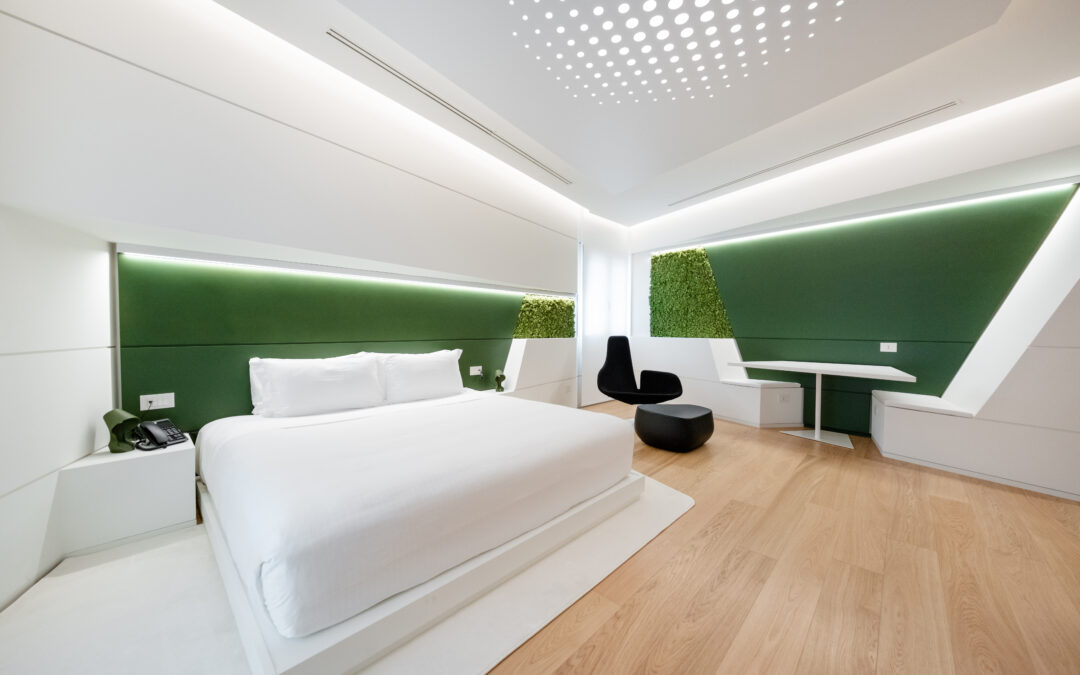
The Greenside concept recalls nature, greenery, and the organic side of living. The entire space is designed with fluid geometries and sustainable materials, where each element – walls, paneling, furniture – dialogues in a unique visual and material narrative.
Saglietti Group realized:
- Custom-made moss green lacquered MDF paneling with natural Mosswall inserts
- Custom built-in bed with single plywood top and integrated nightstands
- Concealed kitchen with melamine-finished wood doors and custom interior compartments
- Integrated TV cabinet in milled paneling for total continuity with architectural language
- Walk-in closet with mirror, paneling and shaped shelves
- Bathroom cabinet with white laminate top and undermount sink
- Custom suspended ceiling light, custom designed to exactly follow the floor plan of the room
A central technical challenge was the perfect continuity of the architectural millings, which run through walls, furniture and lighting. Every detail was calibrated to the millimeter, requiring utmost executional precision and constant coordination on site.
Sustainable materials: aesthetics and responsibility
Every design choice follows the philosophy of the project:
- Use of the Saviola Ecological Panel®, made of 100% post-consumer wood
- White laminated plywood and water-based lacquers
- Components designed according to principles of modularity and dismountability
They complete the intervention:
- Handmade white faux leather cushions and upholstery
- Custom MDF and painted iron coffee table
Collaboration, research and high craftsmanship
Behind Greenside is a constant dialogue between architects, designers and workers. A project born from the vision of Paolo Scoglio and Paola Börner, carried forward with the technical contribution of designers Francesco Arnulfo and Silvia Marassi, and concretized by Saglietti Group’s operational teams at every stage: surveying, engineering, in-house production, and assembly.
The suspended ceiling light, an iconic element of the suite, is a light, sculptural form capable of telling an idea through matter.
Contact us for your customized projects
Do you want to create a space where sustainability, design and functionality coexist in harmony?
Contact us and let’s talk about it together.




Recent Comments