by Eleonora | Apr 30, 2026 | Museum layouts and exhibition spaces
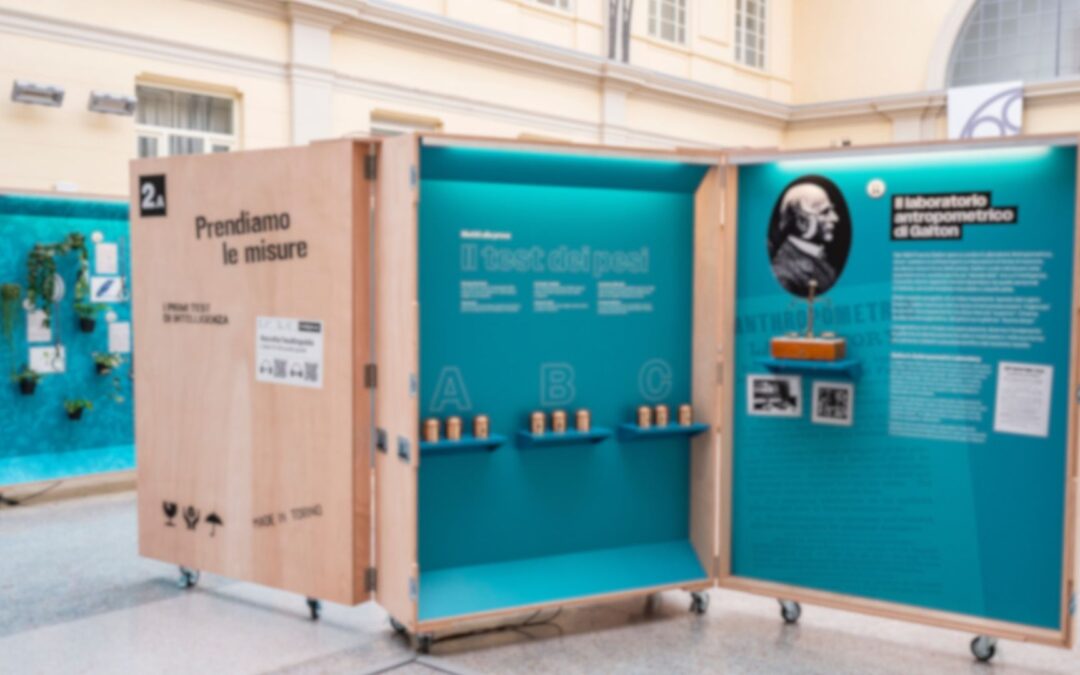
It is a pleasure to find ourselves, just over two months later, once again involved in a project that we had already loved bringing to light at the end of last year. The multimedia and interactive exhibition Intelligènzæ returns in a new guise: not a replica, but a profound transformation that keeps the heart of the project intact, exploring one of the most fascinating questions in science: what is intelligence?
A new format: the exhibition becomes traveling
This edition marks a major paradigm shift: new content, new venue, and above all a rethought design to make the exhibition itinerant and replicable. The challenge was to transform an immersive and complex exhibit into a modular and transportable system. Fundamental was the concept of architect Stefano Grande, who together with our technical and production work shaped an exhibition system “on wheels.”
7 chests and a modular narrative pathway
The new layout consists of seven main caissons plus one final element, designed as autonomous narrative units but part of a single system. Made of okumé, they are designed for strength, lightness and repeatability in transport. Each module opens with different geometries-symmetrical and asymmetrical-creating a dynamic exhibition rhythm.
The interiors, lacquered in light blue, recall the previous edition, while each caisson houses interactive elements such as monitors, digital devices and control systems, creating distinct but coherent experiential micro-environments.
Reuse and design continuity
The final element of the itinerary introduces a key principle: reuse.
An exhibition rack was in fact made from a structure of the previous edition, transformed and repurposed to become a vertical support for a new graphic panel. A gesture that combines memory and design, maintaining continuity between the different stages of the project.
Engineering and technical solutions
Behind the formal neatness is articulate engineering work driven by transportability, safety and durability.
Each caisson is a self-contained system with integrated wheels for handling and a structure designed to distribute loads, reducing stress on hinges and opening points. Plant systems are fully integrated and accessible via removable panels, with ventilation and technical hatches to ensure maintenance and reliability. Dimmable LED lighting is an integral part of the design, helping to define spaces without altering their formal cleanliness.
Industrial language as visual identity
The boxes echo theaesthetics of industrial transport crates, inspired by professional flight cases. A language that is not decorative, but part of the design narrative: logistics becomes visual storytelling.
An interdisciplinary project
Intelligènzæ was born from a network of expertise that combines design, research, and communication.
A central role is played by Taxi1729, a Turin-based organization specializing in science popularization, together with figures such as. Vincenzo Guarnieri and the concept of architect Stefano Grande.
Our contribution focuses on engineering and production, transforming the concept into a concrete, modular and transportable system. Special thanks to Federico Verdi and Davide Di Polito for the technical development of the most complex elements.
Conclusion
Intelligènzæ is not an exhibition to be observed, but an experience to be walked through.
Each element is designed to activate the visitor and turn the visit into a process of discovery.
You leave with more questions than you had upon entering. And that is what the project is all about: an intelligence that is constantly evolving, like the design that houses it.
Photo credits: Paolo Saglia – GiustiEventi
by Eleonora | Apr 17, 2026 | Museum layouts and exhibition spaces
Water, even before being a natural resource, is a true cultural infrastructure. This perspective inspired the design of the new headquarters for the Consorzio Canale Sarmassa, which was inaugurated on March 22, 2025, in the hamlet of Podio, Bene Vagienna.
The Canale Sarmassa, documented as far back as 1596, crosses the Cuneo plain, connecting territories, communities, and agricultural systems along a route that still irrigates approximately 3,000 hectares today. It is a historic infrastructure that is not merely technical but also a defining element of identity. The interior and exhibition design project interprets precisely this dimension, transforming the consortium headquarters into a hybrid space that combines administrative functions, a training center, and a museum dedicated to the memory of water.
An open and collaborative design process
The project was not developed according to a traditional construction drawing, but through an open and iterative process, carried out in close collaboration with architect Michele Bossio (A&T Progetti srl). The continuous dialogue between design and production made it possible to define spatial and technical solutions iteratively, starting from essential guidelines and progressively transforming them into concrete elements of the installation. This approach enabled very direct control over the details and a strong integration between concept and execution. Construction, which began in January 2025 following the site survey in October 2024, was completed in an extremely short timeframe, maintaining design consistency and precision of execution throughout all phases.
Three rooms, one narrative
The exhibition is divided into three distinct yet closely interconnected spaces, designed as a single narrative system that guides visitors from the institutional dimension through the educational dimension to the historical memory.
Conference Hall
The conference hall serves as the primary operational and institutional space. Here, the design focuses on a minimalist and restrained aesthetic, centered around a three-meter-long custom-made lacquered MDF counter, conceived as a continuous volume without visual interruptions. This design choice addresses the need to convey an orderly and authoritative image, in which technology and functionality are fully integrated into the design. The 12-centimeter-high raised platform, constructed with a metal frame and laminate finish, serves an exclusively ergonomic function, improving visibility of the speakers and incorporating accessibility and safety features without compromising the clean lines of the space. The space is completed by modular informational panels that allow for the reconfiguration of content over time.
Study Room
The study room introduces a more open and flexible space dedicated to training and teaching. The bright space, visually connected to the conference room via an internal balcony, features tables, seating, and display systems consistent with the lower level. The central element is a custom-designed reversible whiteboard, made of ABET metal laminate on both sides. It is not merely a teaching aid, but a hybrid technical device that combines a writable surface with a magnetic board, capable of rotating thanks to a specially designed metal structure. Its engineering ensures stability, durability, and great flexibility of use, making it a true work tool as well as a piece of furniture.
Water Museum Hall
The Water Museum Hall serves as the narrative heart of the project. Here, the exhibition design takes on a more technical and conservation-oriented approach, featuring a large custom-built cabinet made of lacquered MDF designed for the management and protection of historical maps and cartographic artifacts. The main challenge was managing the wide-span drawers, which was solved by incorporating metal stiffening elements and a slight structural counter-curvature to control deformation over time. The system incorporates multiple locks and discreet technical solutions that ensure security and functionality without compromising the clean aesthetic. Next to it, an interactive table with an integrated touchscreen introduces a digital dimension to the experience of the content, making the museum space dynamic and accessible.
Materials and Continuity in Design Language
One of the central aspects of the project is the material consistency that runs through all the galleries. Lacquered MDF, melamine-faced panels, technical laminates, and graphic surfaces are not used as isolated elements, but as parts of a single design language. Even the display elements and frames for the historical artifacts are designed to ensure visual continuity, with solutions that combine protection, durability, and clarity of presentation. This attention to detail is never merely decorative but serves the purpose of creating an environment that must simultaneously meet institutional, educational, and museum requirements, while always maintaining a strong overall coherence.
Design as Cultural Infrastructure
The design of the new headquarters for the Consorzio Canale Sarmassa serves as an example of how interior design can become a tool for interpreting the local area. The design does not merely organize functional spaces but constructs a continuous narrative that connects historical memory, contemporary use, and cultural identity. In this sense, the project transcends the logic of traditional furnishing or interior design to approach a form of narrative architecture, in which every element contributes to the creation of a coherent and layered spatial experience.
Collaboration and shared process
The project is the result of a collaborative effort, in which dialogue between the design team, the production team, and the client played a decisive role. The collaboration with architect Michele Bossio and the operational team made it possible to address complex technical challenges, transforming them into solutions that are seamlessly integrated into the overall design, while consistently maintaining alignment between the vision and its execution.
by Eleonora | Mar 12, 2026 | Museum layouts and exhibition spaces
Designing a museum exhibit means finding a balance between artifact preservation, scientific storytelling and visitor experience. It is from this principle that the intervention created by Saglietti Group for the Archaeological Museum of Bene Vagienna, where we oversaw the installation of two new rooms dedicated to the civil basilica of ancient Augusta Bagiennorum.
The museum, housed in the 18th-century Lucerna Palace in Rorà, tells the story of one of the main urban centers of southern Piedmont in the imperial age, founded under Augustus at the end of the first century BC. The expanded exhibition space is part of the cross-border project P.E.P.A. – Patrimoine Environnemental / Environmental Heritage., dedicated to the enhancement of archaeological and landscape heritage.
The staging project
The work involved two new exhibition halls on the second floor of the museum, opening in June 2024. The project was developed in collaboration with architect Michele Bossio (A&T Progetti srl), through a constant dialogue between architectural and exhibition design.
Room A introduces visitors to the excavation activities and construction of the basilica. The space is organized around a large double-sided vitrine that visually connects the two rooms, flanked by infographic walls and a partition wall with an integrated monitor that creates an area dedicated to stopping and exploring. One of the main design challenges was the presence of a pillar and a difference in height between the rooms, which was solved with custom-made furniture capable of integrating both elements and restoring continuity to the path.
Room B, on the other hand, delves into the architectural finishes of the basilica and the objects of daily life. Here the vitrine continues with a taller plexiglass dome to house larger artifacts, while in the center of the room a freestanding vitrine narrates the ceramic and metal materials found during the excavation. The tour concludes with afloor installation that collects fragments of the basilica floor under a large laminated safety glass.
A team project
The intervention resulted from the joint work between designers, museum and technical team. Special thanks go to architect Michele Bossio for the design comparison and to the Archaeological Museum of Bene Vagienna for the trust and vision with which it chose to invest in an exhibit capable of bringing archaeology and contemporary design into dialogue.
by Eleonora | Jan 13, 2026 | Museum layouts and exhibition spaces
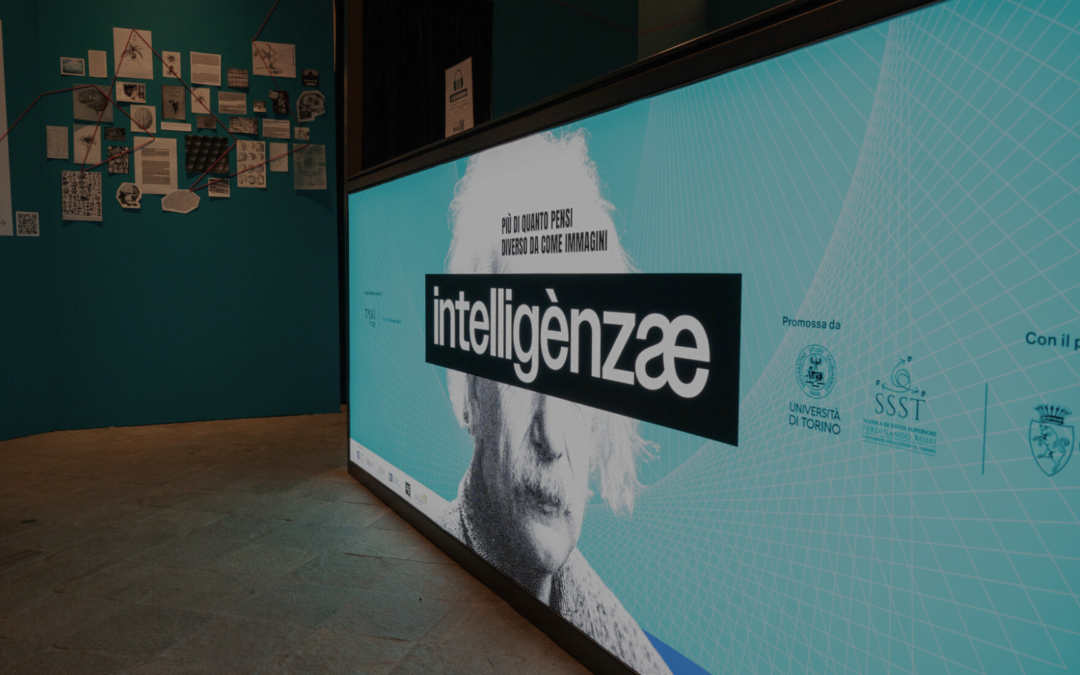
From December 4, 2025 to January 4, 2026, Intelligènzæ, a multimedia and interactive exhibition that takes the public on a journey through neuroscience, evolutionary biology, animal, plant and digital intelligence, comes to life in the spaces of the State Archives of Turin. The itinerary, divided into eight rooms, combines scientific popularization with a strong narrative and scenographic framework, promoted by the Ferdinando Rossi School of Advanced Studies – UNITO and the Educating Future Citizens network under the patronage of the City of Turin. The project was developed by Taxi1729 in collaboration with researchers, scholars and designers from the world of science and design.
For Saglietti Group, experts in custom exhibits and displays, Intelligènzæ was a unique opportunity to transform abstract concepts into physical, playable and tangible devices, combining engineering, design and craftsmanship in every detail.
An immersive, technical and sartorial project
The exhibition itinerary is the result of collaboration with high-level interdisciplinary figures:
– Vincenzo Guarnieri, chemist and science communicator, who specializes in transforming complex content into comprehensible and engaging experiences.
– Stefano Grande, architect and founder of Arsenali Digitali, with experience in scientific exhibit design, lighting design and interactive space design.
– Diego Rizzuto, physicist, who helped make complex scientific concepts clear and enjoyable.
The teamwork enabled the integration of science, design and storytelling in a harmonious way, with a highly technical and tailoring approach.
Key elements of staging
Room 6 – The “T” of the ants
Central element dedicated to collective intelligence, made in three parts of 1 × 1.98 meters, 40 cm high. Tailored red faux leather upholstery, high-density sponge and technical tape handles ensure transportation, assembly and stability.
Room 7 – Shelves for “mindless” intelligences.
Shelves designed for plants, fungi, molds and microbes, with ayous frames and birch plywood tops. Distinctive detail: yellow passivated screws left exposed that become part of the visual language.
Room 8 – Esposit’s Cubotto
Modular interlocking mountable chairs, lightweight and stable, ideal for moments of pause and reflection, customizable according to the visual identity of the exhibition.
Red wire and 3D pin
A red thread guides visitors from one room to the next, made possible by custom-designed and engineered 3D-printed pins for strength and precision.
Other technical elements
Sloping shelves for joysticks, shelving for the Turing Test, bridging elements for the “rubber hand,” technical shelf for the projector: all custom-made following the exhibition’s narrative layout, ensuring visual and functional consistency.
Brandpathy: translating complex concepts into concrete experiences
The project demonstrates how Brandpatia ‘s philosophy can be applied to the scientific world as well: not just displays, but true sensory experiences that make abstract concepts immediately understandable and immersively engage the visitor.
Special thanks
Sincere thanks:
to Taxi1729, for trust and constant dialogue;
to our Exhibit Sales Manager Federico Verdi, for impeccable technical coordination;
to designer Davide Di Polito, who engineered the most complex elements, transforming concepts into fully functional objects.

by etinet | Dec 3, 2025 | Museum layouts and exhibition spaces
In the heart of the Protected Areas of the Maritime Alps, the village of Vernante holds a unique magic: to be the authentic “Pinocchio Country.” This is where the illustrator Attilio Mussino, the “uncle of Pinocchio,” lived, and here his images have transformed the village into an open-air picture book. Against this backdrop, Saglietti Group, together with designers Sara Ambrosoli and Paolo Cavallo of the PinetS studio, initiated a project that began in December 2024: to renovate the Infopoint of the Municipality of Vernante, managed by Atl del Cuneese, creating a place where fairy tale, nature and popularization intertwine.
An immersive journey between fairy tale and nature: the ground floor
Entrance and first installations
The project starts from the ground floor, which has been transformed into an experiential and informative space. Among the main elements:
- Double-sided entrance portal, decorated with images of the village and the Maritime Alps, supported by hidden brackets to comply with underfloor heating: an invisible and scenic solution.
- Second portal dedicated to the two themes of the trail: Vernante and the Park. On one side, graphics of the village; on the other, a maxi-map of the Protected Areas.
- Tripoline curtain wall with a projected waterfall: to ascend to the upper floor you cross the water, in an immersive passage that combines fairy tale and nature.
A storytelling designed to engage children, families and visitors, combining fairy tale imagery and storytelling about the area.
On the second floor: exploration, play and education
Educational and interactive spaces
The second floor introduces a journey through biodiversity, geology and discoveries:
- Cave room with a custom-made central table and stackable transparencies sheets-an intuitive way to follow the evolution of Piaggia Bella cave exploration.
- Magnetic board with animal silhouettes to be placed in their habitat, designed for teaching young children.
- Flora and fauna room: tactile logs to recognize the essences of the Marguareis and tactile boxes to discover the fur of animals in the Maritime Alps.
- Panoramic window with three teaching tables:
- LED light table for tracing images,
- Geological table with real rocks and magnifying glass,
- Tactile table for recreating animal footprints.
- Media room with custom-designed and made blackout curtains.
A setting for all ages
An educational and multisensory environment designed to engage children, families, schools and curious visitors.
Experiential design and bespoke craftsmanship
Materials, aesthetics and functionality
The project combines aesthetics, functionality and respect for the site. Each element-portals, tables, tactile supports, display structures-was custom-built in our workshops, combining invisible technical solutions, durable and natural materials, and set-ups designed for continued use by families and schools.
A choral project shaping the magic
The work of the team
This intervention was made possible thanks to the professionalism of the team: Daria Bergese for design, Fabrizio “Ciko” Olivero for technical solutions, and Samuele Chiesa, Sofian Ait Lahcen, and Alessio Giacobbe for editing.
Together we have built a place where fairy tale meets mountain, where children explore and adults find wonder.
In Vernante, from a simple piece of wood…the magic of Pinocchio is born again.
Are you an institution, museum, or foundation?
Tell us about your project: we create tailor-made installations, educational spaces and narrative paths for territories, museums and cultural institutions. Contact us to design and create immersive and educational environments that enhance your heritage.
by etinet | Nov 14, 2025 | Museum layouts and exhibition spaces
Custom-made furniture for an innovative and inclusive educational hub
In the heart of Cuneo, urban regeneration promoted by the CRC Foundation takes shape in the Rondo dei Talenti, a multifunctional building entirely dedicated to personal growth,inclusion and training. For this space, designed by Officina82 with construction supervision by arch. Marco Oriani, Saglietti Group made all the custom supplies, from the reception desk to the mobile furniture, interpreting with precision and care the values of accessibility, participation and creativity that animate the project.
A layout to serve the educational experience: from reception to laboratory areas: functionality and attention to detail
Front desk and reception area
The ground floor opens with areception area featuring a prominent Ayous/Obeche solid wood counter, made of more than 150 shaped and hand-applied strips, finished with laser-etched lettering directly on the uneven surface. The structure integrates a curved LED strip and a shaped layered laminate top, ensuring a distinctive and functional visual impact. Concealed cabinets with vertical battens flush with the wall and custom-made mobile containers with wheels, optimized for visual merchandising, complete the environment.
Talent Zone and Free Space
In the heart of the ground floor, spaces dedicated to workshops and creative activities were furnished with CNC perforated panels for displaying materials, modular billboard systems, tablet and headphone holders, and interactive notepads. The counters with a planked structure echo the aesthetic language of the reception desk, with differentiated functions for staff and users.
A project that grows floor by floor: handcrafted and modular solutions for versatile environments
WOW Space
On the second floor, the WOW Space houses a bookcase-tree made of molded spruce plywood designed to wrap around a central pillar. Adhesive PVC ceiling graphics were precisely calibrated to avoid interference with technical installations. Curved plywood benches with faux leather seats and colorful MDF storage units complete the environment.
The Chamber
In the adjacent training room, a bookcase with a reclining top and slatted structure is flanked by sound-absorbing caissons covered in cork or chalkboard laminate, designed for intensive and flexible use.
Plin Space
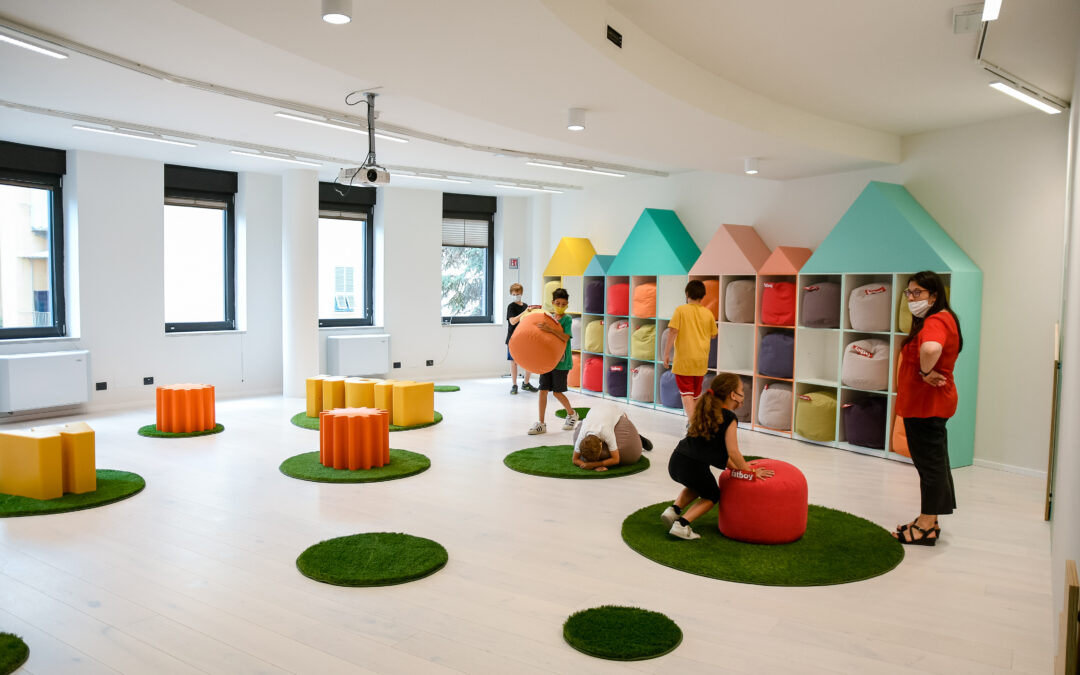
The second floor houses the Plin Space, set up with the Esposit line by Saglietti Group: interlocking wooden modular systems, Tango birch tables, Cubotto stools and Scacco Matto partition modules, all designed to be assembled and disassembled with ease, ideal for ever-changing educational spaces.
City of Talents
Also on the second floor, achild-friendly area houses melamine pouf houses with colorful roofs, chalkboard walls on wheels customized with the swallow symbol, and flexible solutions for inclusive education.
Growing talents: design for education and guidance
Thematic cottages
The third floor expands the Talent City concept with eight small houses dedicated to different types of intelligence. Structures made of Swedish pine lath and colored fire-retardant MDF accommodate custom tables, cubes, technology supports and custom signage.
Skyline and iconic furnishings
A skyline panel with shaped elements and an integrated clock draws the “imaginary city” that connects the two main rooms. The graphic elements, pantographed and printed, are designed to stimulate identification and discovery.
Relationship Space
On the highest level, an event room with a rooftop terrace is furnished with a circular pulpit made of curved, perfectly fitted slats and a matching counter. The space is arranged to host conferences, meetings and workshops.
Collaboration, identity, future: an arrangement designed to evolve with the community
The project Rondò dei Talenti represents a concrete example of educational architecture in which the layout is not merely a complement, but an active tool for enjoyment. Thanks to the synergy with architects Lara Sappa and Fabio Revetria (Officina82), with the client Fondazione CRC, and with professionals such as Giusti Eventi and Daniela Tini for graphics and illustration, Saglietti Group was able to fully express its approach: listening, precision, craftsmanship and attention to context.
Are you an institution, firm, or foundation?
Tell us your project: we shape educational, museum and public spaces together. Contact us to design and create custom furniture for cultural, institutional or educational environments.




Recent Comments